


"LET'S NOT PROVOKE RUSSIA"

And once again – heard so many times before, reeking of the Moscow regime, as black as the dirt beneath the fingernails of a Kremlin stooge, decades old, conducted by a KGB lieutenant colonel, immersed in the imperial mists of chauvinism, the melody of the Russkiy Mir. Overpowering all others, both in Lithuania, in Russia, and abroad, reinforced by the classical instruments of propaganda, an aria composed by psychological operators: very soon, quite possibly already this evening, and if not today, then certainly in the near future, definitely, definitely sometime soon, Russia will begin.
It will begin a large-scale offensive against Lithuania, against Narva, against the Suwałki "corridor," against the Baltic States, and – how frightening! – Finland. Maps with arrows are being drawn, strikes against Vilnius, Tallinn, Riga, Suwałki, and so on are being depicted. AI-generated images spread across the internet, echoed in chorus through both official and unofficial channels by groups of cuckoos hired by Moscow.
This information is being disseminated so widely and actively that worried journalists call us in Brussels, in the heart of NATO, beneath the sign reading "Strategic Communications," because people are left with the impression that everyone is talking about it – that is, every news portal and every button on the television remote – although that is not actually the case. This is the result of psychological influence.
In these activities, a very clear role is played not only by the easily identifiable Kremlin SVR agency, but also by the so-called Russian opposition, the "good Russians," who reveal themselves quite clearly to us as operating under cover. One well-known figure claims to be persecuted by Putin's regime, yet for some reason wanders around Narva near the Russian border, speculating about where and when turmoil will soon begin.
Another "critic of the Minsk regime," emphasizing that she lives between Vilnius and Poland, clucks about how growing confrontation with Moscow, drone attacks, and other actions could encourage Russia to expand the war both against Ukraine and – naturally, how could it be otherwise – against the Baltic States. You probably understand, just as we do, that the purpose of such messages is to create the impression that Russia is already fighting the Baltic States on a physical, conventional battlefield front line and can only intensify its actions further.
Such statements, this tossing around of watery diarrhea-like war prophecies, have been especially abundant in recent weeks. We regard this as yet another information operation by Russian intelligence services against Lithuania. What is Moscow trying to achieve? Moscow seeks a very simple objective – to create the illusion that it is capable of fighting not only against Ukraine but also of opening another front. The creation of such an illusion is intended to give the impression that Moscow is capable of fighting and winning another war, for example against Lithuania, Latvia, or Estonia.
But here we ask you to stop. This narrative is only words. It is a propaganda construct, because Russia today is incapable of conducting direct military operations not only against Lithuania, but even against smaller states that it constantly threatens.
For over a month now, almost daily, Moscow has been threatening Yerevan that if Armenia follows Ukraine's path together with the European Union, it will face a fate similar to Ukraine's. Yet even Yerevan, potentially under threat, responds to these intimidations very calmly, understanding the hopeless situation in which Russia finds itself.
When hearing Muscovite threats, there is no need to panic, because that is precisely what the Kremlin expects. Most importantly, one must understand that the regime operates according to a model that has remained unchanged for many years, the so-called multi-layered mnogokhodovka. This means a multi-layered move, in which several objectives are pursued simultaneously.
First, there is an effort to convince the West and continuously reinforce the idea that Lithuania and the Baltic States are some sort of ambiguous entity; as if they were not part of NATO and the European Union, but some separate grey geopolitical zone, similar to Ukraine or Moldova, some vague "Russians" whose supposedly historical political and geographical place is nowhere else but within Russia. This is an opinion-shaping operation conducted according to old KGB textbook tactics, intended to influence decision-makers by convincing them that the Alliance or the West in general (to which Lithuania allegedly does not “belong”) should not concern itself with the Baltic States if their independence were threatened.
Second, the aim is to frighten you (us). Just as a cobra attempts to paralyze its prey, so this propaganda seeks to create the impression that we have lost the war before it has even begun, because we supposedly lack the strength, the will, and the combat capabilities to resist, making resistance pointless. The message is repeated constantly: war is inevitable, resistance has no chance, our ability to defend ourselves is minimal, nonexistent. In this way, the operation follows Sun Tzu's idea from The Art of War that victory must be achieved before the war even begins, by creating within the enemy's ranks a mood of inevitable defeat.
Third, there is an effort to convince Russian citizens that the Kremlin regime stands firmly on its feet because it is "fighting" not only all Western countries in Ukraine, but is also capable of attacking another European state simultaneously.
You have probably noticed that terms such as "NATO," "the Alliance," "collective defense," and "Article 5" are absent from such narratives. Instead, there is constant talk of Lithuania, Latvia, Estonia, and Poland as if they were completely isolated geopolitical entities whose very statehood is false, illegitimate, a historical mistake, an error in Europe's development. In Kremlin agent narratives, Russia attacks Eastern Europe, attacks Lithuania, attacks the Baltic States. Under no circumstances does it attack NATO, the EU, or the United States.
This is no coincidence. All these texts are constructed in such a way that Europe is divided and the Baltic States are removed from the NATO context. As if we lived in the eighteenth or nineteenth century, and the Russian Empire were organizing a campaign against Warsaw or Vilnius, which supposedly "belong" to it, while alliances and mutual assistance treaties simply did not exist.
This is a constant and fundamental informational objective of Moscow – to demonstrate that the North Atlantic Treaty Organization is a paper tiger, ineffective, not merely drowned in bureaucracy (which would at least acknowledge its ability to act, however slowly), but frozen, "dead." Essentially, the attempt is to show that Article 5 does not work and will not work. Yet Article 5 must first function in people's minds so that it may later function in reality. Therefore, this information operation is directed at our consciousness as Westerners.
Of course, Russian propaganda fantasies do not determine the decisions of NATO's highest-ranking political and military leaders. However, the messages of Medvedev, Putin, and other figures do spread, reach part of the audience, and shape attitudes. Such messages must be answered firmly and decisively.
Therefore, to us, the "discussion" surrounding the statement by Lithuania's Foreign Minister that, in the event of an armed attack, Russian military facilities in the Kaliningrad region would be struck, appears not merely strange, but treasonous.
Hearing reactions that the minister is supposedly "provoking Russia," "going too far," or "failed to coordinate" his statement with someone raises a question based on the arguments outlined above: are those speaking this way simply incompetent fools, complete blockheads, halfwits who have drunk away their brains, useful idiots serving Russia, or are we dealing with the invisible influence of Russian intelligence services, which, if it exists – and we guarantee it – will eventually reveal itself.
Messages similar to those of K. Budrys have been publicly expressed many times by American generals and Western politicians. What, for heaven's sake, should Alliance strategists say instead? That if Russia attacks NATO, we will wait, tremble in fear, express concern with sweaty palms, and not strike back?
These "discussions" arising "because of Budrys' statement," which are in reality nothing more than whining, are nothing new. Before the January Events, before March 11, and before the fateful year 1940, the same track from the scratching, stuck MGB/KGB record could be heard: "Let's not provoke Russia." We heard the same thing during various other historical periods. Let's not provoke. Let's give way. Let's not anger them. Let's adapt. In other words – let's surrender.
It was precisely such a policy of appeasement, silence, looking away, adaptation, and collaboration that cost us our freedom and hundreds of thousands of lives ever since the partitions of the Polish–Lithuanian Commonwealth. Any trembling that allows Russia to think we are afraid only unties its hands. Conversely, a clear position that we will defend ourselves and resist to the very end, striking with whatever is at hand, and when ammunition runs out, splitting the face of an invading occupier with an iron or a poker, is the strongest deterrent.
Such, and no other, must be our message: clear and completely unambiguous even to toilet thieves and representatives of the Russkiy Mir. If anyone attempts to undermine Lithuania's independence, we will defend our state just as our grandparents and great-grandparents did. They drove the Bolsheviks from our land; so shall we.
Another very important signal we have been seeing recently is Russia's attempts to raise the issue of the so-called "protection of Russian-speakers' rights" in international organizations. Moscow constantly speaks about allegedly violated Russian rights abroad, about the need to protect "compatriots," "Russian-speakers," the "Russian cultural space," and so forth.
This rhetoric is not new. It was precisely this logic that underpinned previous Kremlin interventions and pressure against neighboring states. It is a classic scheme of imperial policy – first declaring that Russians or Russian-speakers are supposedly being mistreated somewhere, and then reserving for Moscow the right to act as their alleged defender. In this way, a political and informational basis is created for interference in the internal affairs of other states. In Russian foreign policy doctrine, the so-called "protection of compatriots" has for many years been used as an instrument of geopolitical influence.
However, the context we have mentioned repeatedly is very important. Therefore, in this specific case, we see the Kremlin resorting to a bluff, clutching at straws. Because another process, increasingly visible even to others, is becoming unavoidable: Russia is losing its imperial power and the influence built on armed ragged troops bogged down and dying in Ukraine, as well as on blackmail.
It is losing not only positions in Europe but also in regions it long regarded as its exclusive sphere of influence. Even in the South Caucasus and Central Asia, a growing tendency is emerging to bypass Russia, which is becoming toxic even to China at the table of global power diplomacy. New trade and logistics corridors from China through Kazakhstan, the Caspian region, the South Caucasus, and Turkey are being rapidly developed. These routes are being created so that goods can move between Asia and Europe without dependence on Russia or its territory. This is a strategic shift showing that even Moscow's traditional partners are seeking alternatives.
Thus, today we see a paradoxical situation. The more Russia loses real influence, the more aggressively it attempts to create an illusion of power in the information space.
Let us not yield to intimidation.
The intimidators themselves are trembling with fear.
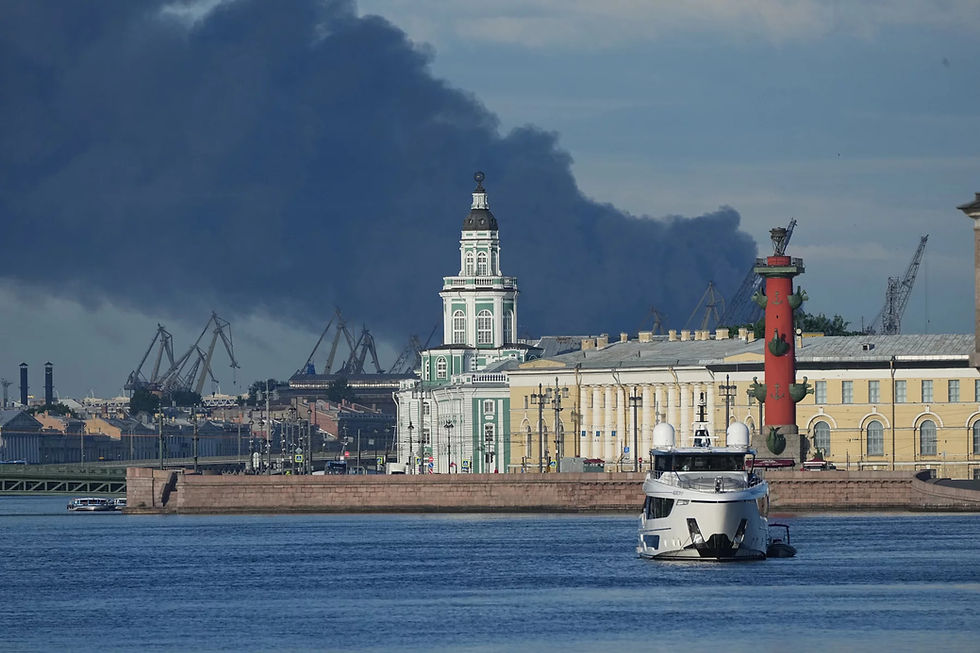
Photo: Ukrainian drone strikes targeting the Russian regime in Leningrad (Saint Petersburg), June 3, 2026 (Source: AP)



Comments