


THE COLLAPSE OF THE PUTIN REGIME

Despite threats involving the “Oreshnik” system and its likely use on the ground in Ukraine for the second time in nearly four years of full-scale war, Russia’s “power” increasingly resembles the deflated pride of an impotent man. An imagined pride—truth be told, there was never anyone to boast before, nor anything to boast about. This pride is being desperately revived by staring at screens inside a bunker in the Urals. On all of them—a tattered Putin’s Russia, sinking into an economic, political, and diplomatic abyss. The approaching and inevitable collapse is now being openly signaled by Volkov-type figures and other “naryadchiki” from the moderate branch of the SVR, who until recently played the role of a fictional Kremlin opposition.
A Black Raven Circles Above the Kremlin
The clearest example of this is the U.S. special operations forces mission near Iceland, during which a tanker from Moscow’s shadow fleet and its crew were detained. The seizure was carried out despite a Russian nuclear submarine being dispatched to escort the tanker—an unmistakable act of nuclear saber-rattling. The United States ignored both demands to release the vessel and threats shouted over the red phone line. Moscow was left with no option but to humbly settle for requesting the release of the crew members—more precisely, the SVR/GRU agents fleeing Caracas who were aboard.
Washington no longer takes Russia into account. And America does this openly: when asked how Russia would react to an attack on Venezuela, M. Rubio replied that Russia is bogged down up to its ears in Ukraine and is dealing with its problems there. Moscow has lost not only the geopolitical weight and influence it possessed when Putin was elevated to the Führer’s throne, but also the ability to operate meaningfully beyond Russia’s borders.
Over eleven years of war against Ukraine, Russia has lost influence in the Middle East, Africa, Latin America, and even in the Indian Ocean, where it once pompously participated in military exercises. Strategically important Kremlin supporters are gone—neutralized: Venezuela and Syria. And the events of last night also signal that the Iranian ayatollah regime is collapsing. How long it will hold is perhaps known only to analysts at Israel’s Mossad. Painful blows—some would call them coincidental (though you and we know there are no coincidences)—have converged simultaneously, resulting for the Kremlin in the loss of oil price leverage, resources, and influence.
After the arrest of “Bela 1” and the announcement of new sanctions against Russian energy companies, Moscow finally realized that Washington never intended to be its ally. The U.S. administration, without any disguise, scruples, or compromise, acts solely in accordance with American interests—it does not merely find Russian coordination unnecessary, it finds it irrelevant.
Putin was undoubtedly shaken by the White House statement made the day before yesterday announcing that by 2027 the U.S. defense budget would be increased to $1.5 trillion—50% more than the previous year. These words, we have no doubt, will turn into actions which, unlike the usual verbal masquerading of democracies, constitute a horrific dream, an unplanned nightmare for a Russia drowning up to its ears in war.
It is one thing to talk about the Western Hemisphere as a U.S. zone of interest into which no one may interfere. It is something entirely different when “Bela 1” and yet another Russian tanker are detained in complete disregard of any protests. The fact is that the United States is already acting as the master of the part of the globe it has declared its zone of interest. To rather a bit silly observers who still believe they can moralize and shame a global superpower for violating laws and international norms, Trump cuts dryly: “I am the law.”
In the Ural bunker—confusion and silence. There is nothing left to threaten with. And this is only the beginning
Moscow will have to come to terms with the fact that the world’s key resources—oil, gas, rare earth metals—will soon be controlled by the United States. Beyond the already demonstrated displays of military power in special operations, the U.S. intends to activate military actions in Nigeria and, if necessary, in Iran. To those accustomed to debating the legal aspects of the welfare of caged chickens, this may seem insane. To us, it is an obvious part of a comprehensive plan. History repeats itself: the United States will be able to swiftly drive a country—a nuclear gas station whose economy is 40% dependent on hydrocarbon revenues—into bankruptcy.
We repeat: these are no longer intentions, words, or signals, but real actions, and for Russia they mean catastrophic consequences (even though the primary adversary and target remains China). Regardless of how relations between the U.S. and other Western countries evolve within the EU and NATO, a Russia rolling into a pit of poverty will find it extraordinarily difficult to claw its way back up and pretend to be a geopolitically significant player.
Not only do we understand this—so do Kremlin strategists. The planned “three-day war” and the renewed rise of Russia’s global influence ended in complete nothingness. Worse than nothing: the war initiated by Russia became unintentionally beneficial to the United States, which could not help but exploit Moscow’s shortsightedness. Meanwhile, the war that was deliberately useful for Beijing—which pushed Putin into this military adventure—has turned into an unpredictably expanded U.S. influence and a very real threat to the Chinese Communist Party’s century-long plan, laid out by "the great" Mao, to become the world’s leading power by 2049.
The Kremlin’s main problem is that Putin’s team has no clear plan for the future. Desperate lies accusing Kyiv of attempting to attack Putin’s residence, childish whining, and retaliatory strikes against apartment buildings killing civilians demonstrate that the strategists of Russia’s “war party” are exhausted.
Putin has no moves left. His only plan is war—a war doomed to failure. Under the continued rule of Putin’s gang, Russia will at best turn into an impoverished, starving, garbage-dump-dwelling copy of North Korea. This is the price Russian society is already beginning to pay for the plans of its incompetent strategists and their attempts to seize Ukraine.
Against the backdrop of this seemingly hopeless war, increasingly loud signals are emerging from certain new—or rather refurbished—segments of the Russian “elite.” Even before the full-scale invasion of Ukraine, within Russia’s FSB, and especially the SVR, there were some strategists who opposed the plan of tank columns and missile strikes (likely knowing the true condition of the world’s so-called “second-best” army). They sought alternative scenarios for subjugating Ukraine. After the occupation of Crimea, there were proposals not to continue military operations but to turn the peninsula into a flourishing Russian “Monaco,” demonstrating to Europe a different economic perspective and direction. Unfortunately, the faction of general-morons prevailed—those who know and can do only one thing: destroy, annihilate, and rape.
This futureless Russia of Putin & Co. is well understood by the subordinates of Bortnikov and Naryshkin in the departments where Russia’s future plans are being drafted. That is precisely why—hold tightly to the armrests within reach—part of the Russian “elite” is now openly talking about the need to stop the war and return to fundamental values: “human life, human rights, family, and individual creative freedom.”
Against the backdrop of massacres and the destruction of Ukrainian cities, such a “values shift” in the minds of Russia’s so-called liberal wing emerged only after a head-on collision with the overt policy of U.S. dominance, which allegedly has no ideology or meaning beyond profit and force. Therefore, the rational—let us call them that—faction of Russian politicians proposes an immediate ceasefire, negotiations, and a transition toward a new format for building Europe, which they claim is impossible without coexistence between Russia and Ukraine.
In this future construct, clearly seasoned with Duginist flavors and stretching from Lisbon to Vladivostok, the foundation would be a redefinition of relations among European states, security priorities, and values. At the center of this new superpower and counterweight to the United States would be a different Russia, using its resources to build a bridge between the Urals in the east and Brussels in the west.
Naïve? Undoubtedly. But this is a very Russian way of extending a helping hand. It appears that this hand is being extended from Moscow by those who clearly see how rapidly Russia is becoming a pariah state, and at what cosmic speed it is—no longer metaphorically—turning into a cesspool.
Kremlin strategists are searching for new formats and vectors that would preserve Russia as a functioning, albeit limited-power, center in the future. Given that post-Putin replacement scenarios are already circulating publicly, and that Americans are warning of possible internal upheavals in Russia, we must prepare for turbulence. The fall of Putin’s junta may occur suddenly and unexpectedly.
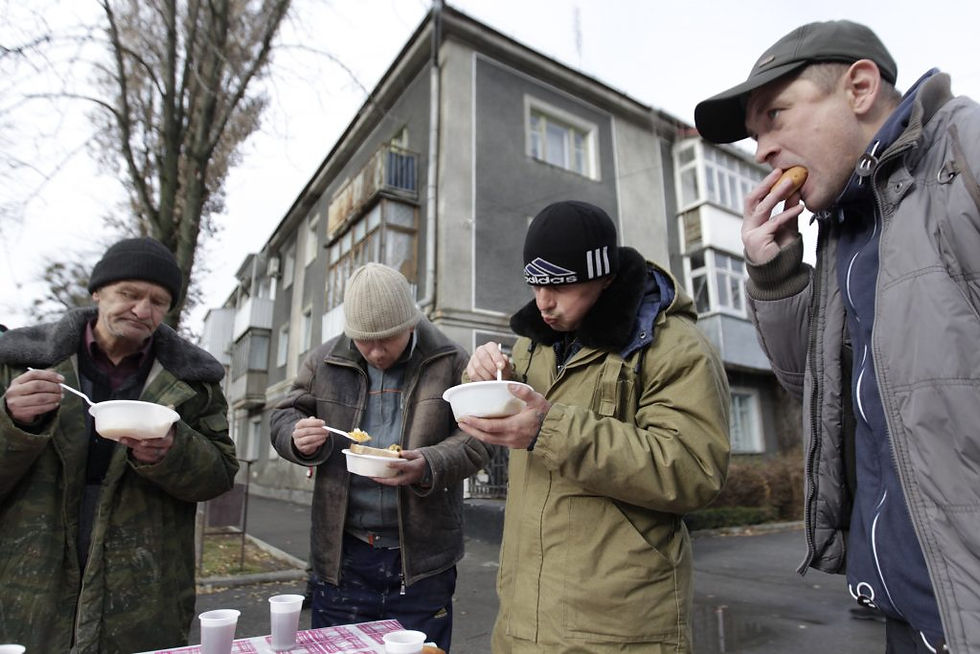
Photo: somewhere in Russia.



Comments